

If you find value in these reflections, you are likely missing out on the deeper, more specialized layers connected with this ecosystem built to improve you:
The Foundation: Understand the frameworks and mentors that inform this methodology at On the Shoulders of Giants.
The Toolkit: Access the Free Resources to start auditing your current digital footprint.
The Accelerator: For those ready to bypass the trial-and-error phase, the VIP Premium Packs provide the exact systems used to scale professional influence.
Ah… And if your focus is not only on your visibility, but also learn the internal systems of your career and personal growth, you should check Meller Notes.
I was thinking about one of our last conversations, the one about building visibility without feeling like a total fraud, and something really interesting happened in my inbox...
A lot of you seemed deeply relieved, and I don’t mean the “I found a new LinkedIn hack” kind of relief, but rather that heavy sigh that says, “Finally, someone admitted the awkward part out loud.”
We are all living with this weird tension, right?
We know that Visibility matters, and we know that the best opportunities usually go to the people whose work is easy to see and remember... but we also really, really do not want to wake up one morning and realize we have turned into a walking motivational quote.
Nobody wants to be that person... at least nobody I would actually trust with a budget or a serious project.
The Exhausting Language of Modern Work
To be honest, the way we talk about being seen online has become completely exhausting... words like Personal Brand (how the world sees your professional “identity”) or Content Strategy (the plan for what you post) feel so heavy.
It starts to feel like you are just one Canva template away from losing your soul, or like you are being forced to build a “funnel” for your life while you sleep.
Let’s try a much calmer route together... because maybe the goal isn’t to become the loudest person in the digital room.
Maybe the real goal is to build something much more senior, much more useful, and significantly less “cringe” (that feeling of embarrassment we get when someone is trying way too hard).
We are talking about a Professional Reputation.
Your Judgment is the Only Thing That Lasts
What if we looked at reputation as simply your Professional Judgment made visible?
Reputation isn’t just about being seen, because plenty of people are seen every day and then forgotten five seconds later (usually right after they ask us to comment “YES” for a PDF we never wanted).
A real reputation grows when people start to associate your name with a specific way of thinking... they start to understand what you actually pay attention to.
They begin to notice:
The specific types of problems you are good at spotting before they explode.
The Patterns you see that others usually miss.
The kind of Value (the actual benefit or profit) that follows whenever you are in the room.
A trophy says, “Look at what I did,” but a Reputation says, “Here is how I think when the work gets real.”
This is the big shift for those of us who hate self-promotion... you don’t need to convince strangers that you are “impressive,” you just need to make your judgment visible enough so the right people know what they can trust you with.
This is especially true for senior roles, because the work we do is often strangely invisible... things like Strategic Trade-offs (deciding what to sacrifice to win elsewhere) or Risk Management (predicting what might go wrong) are hard to see from the outside.
If we don’t explain how we think, people will only see our job title... and let’s be honest, a title almost never tells the full story of who you are or what you can do.
The Problem With Letting the Work Speak for Itself
I know many of us were trained to just “do the work” and let it speak for itself, and I truly understand that instinct because it feels noble and professional.
It feels clean... and it keeps us far away from that “Big Announcement” culture where every Tuesday is treated like a life-changing milestone.
But there is a catch... work does not always speak clearly on its own.
Most of the time, your work only speaks to the people who were standing right next to you when it happened.
Inside your current company, people might know you are the one who “connects the dots” or calms the room during a crisis... they know you can translate a messy Strategy (the high-level plan) into something the team can actually execute.
But outside that building... none of that is obvious.
The market doesn’t automatically know your depth, and future opportunities don’t just “appear” because you did a great job in silence for five years.
This is where we get stuck... we think the only choice is “Silence” or “Self-Promotion,” so we choose silence... but silence has a very high cost.
It makes your entire career dependent on private rooms, lucky referrals, or the memory of people who might not even explain your value correctly when you aren’t there.
Nobody will ever explain your value with the same precision and care that you can.
When someone says, “She is really good,” it is helpful, but it isn’t a Market Position (a clear reason why someone should hire you specifically).
Our job isn’t to get louder... it is to make our value easier to understand so that nobody has to “translate” us badly in a hallway conversation.
Does This All Feel Like a Performance to You
After my last post, some of you asked a really tough question... if we all start “sharing our maps” and acting like teachers, doesn’t that just become another kind of performance?
That is a very fair point, and it’s something I worry about too.
Any good idea can eventually become a costume... even “Authenticity” can be faked if we aren’t careful.
We have all seen it... the posts that start with “Here are the three humble mistakes that made me a visionary”... please, let’s just not do that.
The answer isn’t to “package” yourself better... the answer is that the Substance (the actual quality and depth) must survive the packaging.
A principle only matters if it came from real practice and real scars... a framework only helps if it actually makes a messy problem feel clearer.
The internet is already full of actors, so our opportunity is to make the reader feel something different:
That you have actually done the hard work yourself.
That you understand the painful Trade-offs involved.
That you aren’t pretending the world is simpler than it actually is.
You aren’t trying to be a better actor... you are just trying to be easier to trust.
The Secret Layer of Every High-Level Referral
There is a common myth that senior leaders don’t care about LinkedIn or online content because they hire through “referrals” only.
To be honest, a busy executive probably isn’t going to scroll for ten minutes and hire you on the spot based on one post.
That isn’t how trust works... most big opportunities still happen in private rooms and through “Who do you trust for this?” conversations.
But here is the secret... Referrals always need verification.
When someone hears your name, what is the first thing they do? They look you up... they check your profile... they read something you wrote to see if the recommendation matches the evidence.
Your online presence might not create trust from zero, but it can definitely strengthen or weaken the trust that arrived through another channel.
Think of your content as a Trust Verification Layer.
It gives your advocate something to forward to their boss... it gives your future partner a way to see how you think before they ever pick up the phone.
How to Build Your Reputation Stack
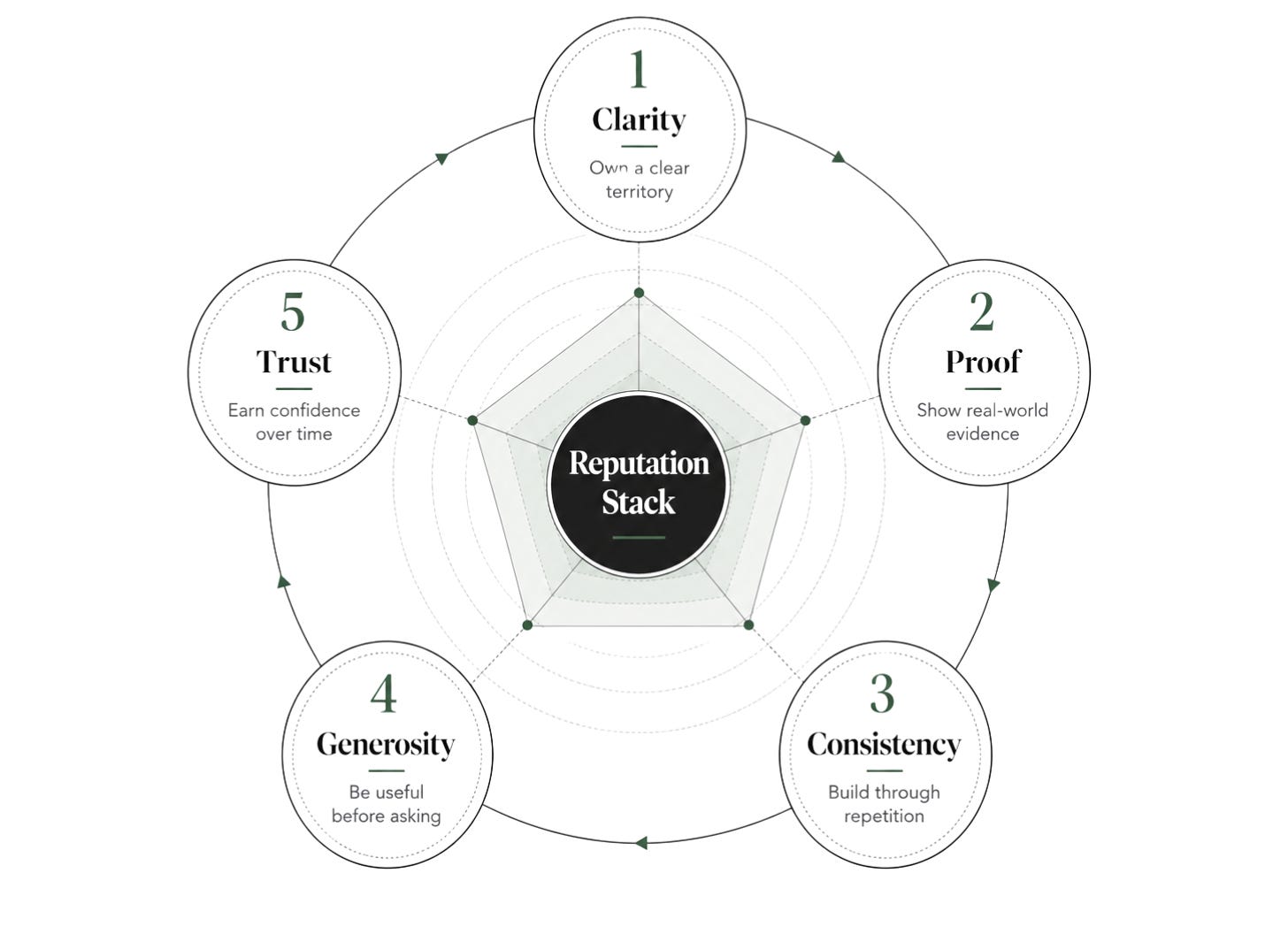
If you hate the idea of “promoting” yourself, you need a system that relies on logic instead of hype... I like to call this The Reputation Stack.
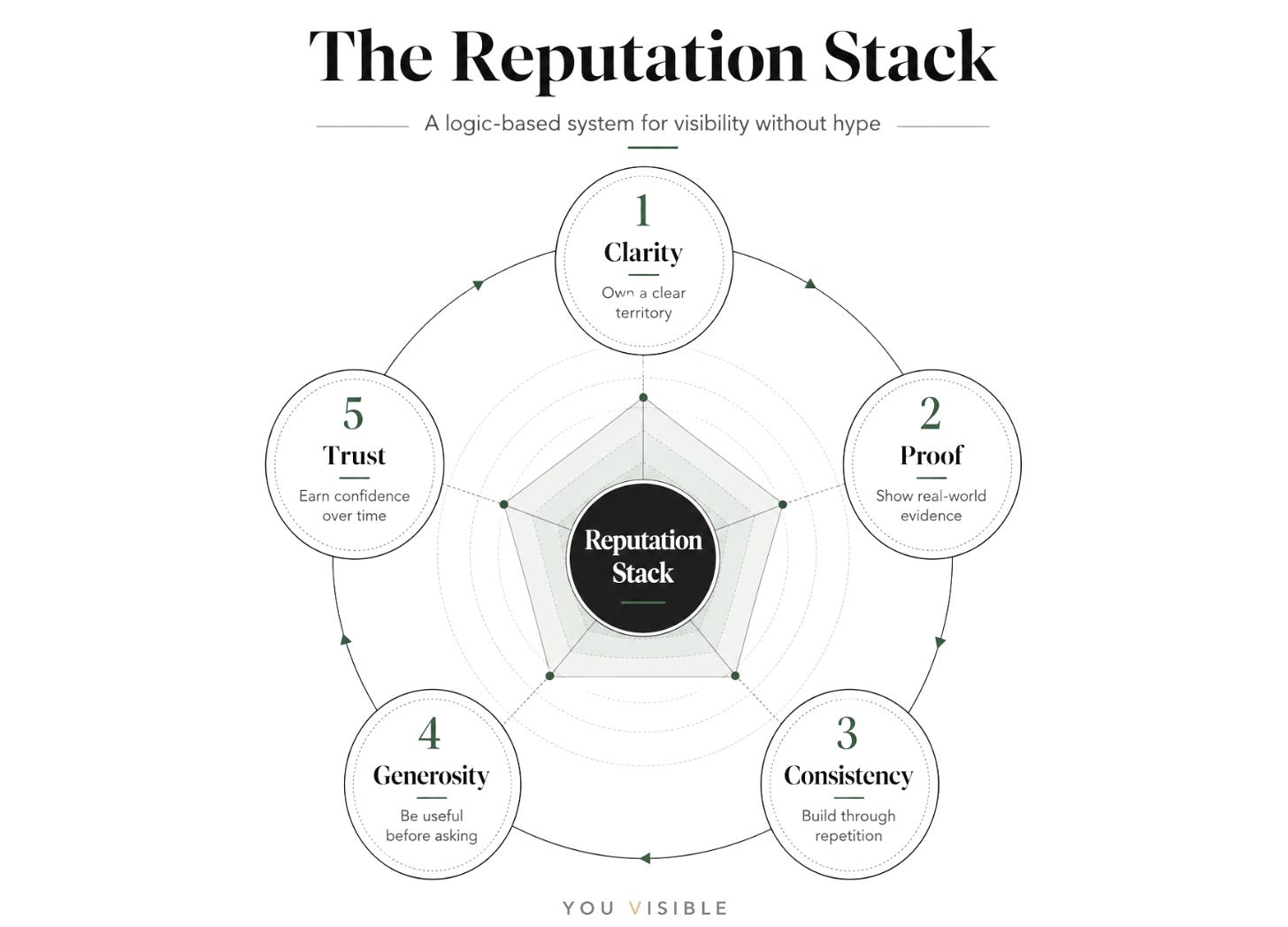
1. Clarity
People need to know exactly what “territory” you own in the professional world... this doesn’t mean you are trapped in one niche forever, but you need enough repetition so people associate you with a specific problem.
Are you the person who knows how to turn complex IT Strategies into reality, or are you the one who helps professionals build their brand?
The more clear you are, the easier you are to refer.
2. Proof
Proof is not the same as bragging... it is just helping people see that your ideas come from the real world.
You can show proof through stories, specific decisions you made, or even the mistakes you survived.
Don’t just say a project was successful... explain the Decision Rhythm (the frequency and style of making choices) that actually made it work.
3. Consistency
I know this part is annoying, but reputation needs repetition... you might feel bored saying the same thing, but your reader probably didn’t see it the first time.
What feels “repetitive” to you usually feels “clarifying” to the person reading... one good idea can be a story today and a practical checklist tomorrow.
4. Generosity
The best way to avoid feeling like a salesperson is to be genuinely useful.
Generosity means letting people experience the quality of your brain for free... sharing a question that helps them think better, or a framework that makes a messy task easier.
Sometimes your reputation grows most through a single, thoughtful comment you leave on someone else’s post.
5. Trust
Trust is just the result of the first four layers working together over time... it grows when people realize you aren’t trying to manipulate them.
In a world full of “optimized” voices, a calm and grounded voice stands out much more.
What to Write When You Aren’t a Content Machine
The good news is that you already have all the material you need... you don’t need to “invent” a personality.
Just look at your actual life:
Recurring Problems: What issues do you solve every single week? Write about the pattern, not the secrets.
Common Questions: What do people always ask you? If they are asking, it’s because your knowledge is valuable.
The Hard Decisions: Talk about the Trade-offs... why was a specific choice difficult?
Most professionals underestimate themselves because they think their knowledge is “obvious”... but what is obvious to you is often a revelation to someone else.
Sharing the Map instead of the Image
At the end of the day, you don’t need the whole world to know who you are... you just need the right people to understand what you can be trusted with.
A strong reputation makes you Findable, Credible, and Memorable when the right opportunity finally appears.
It doesn’t require you to be fake or loud... it just requires you to be disciplined enough to make your judgment visible.
You don’t need to sell your image... You just need to share your map.
But please, make sure the map is real and that it comes from places you have actually walked through... that is the only reason why anyone will ever trust it.
You know… The difference between a professional who is “busy” and one who is “influential” often comes down to the quality of the assets they build.
Don’t leave your reputation to chance or the whims of an algorithm.
Take the next step in your professional evolution:
Review the Sources: See the logic behind the strategy at Sources & Giants.
Use the Resources: Download the guides on the Resources Page.
Upgrade to VIP: Get the complete execution framework via VIP Access.
I love this reputation stack just makes it stupid simple. Consistency is personally the hardest nut to crack for me!
I love cringe but love this framework more