

If you find value in these reflections, you are likely missing out on the deeper, more specialized layers connected with this ecosystem built to improve you:
The Foundation: Understand the frameworks and mentors that inform this methodology at On the Shoulders of Giants.
The Toolkit: Access the Free Resources to start auditing your current digital footprint.
The Accelerator: For those ready to bypass the trial-and-error phase, the VIP Premium Packs provide the exact systems used to scale professional influence.
Ah… And if your focus is not only on your visibility, but also learn the internal systems of your career and personal growth, you should check Meller Notes.
Last week, we talked about something that apparently hit a nerve…
Some of you wrote back, commented, forwarded the post to colleagues, and said some version of the same thing: “I know I need to do this, but I have no idea where to start.”
This is the post, if you missed:

That is exactly the reaction I was hoping for, and also the one that told me we needed to go one level deeper together… Because here is the honest problem with frameworks: they are easy to understand and hard to execute.
You read a five-step system, you nod your head, you think “yes, this makes complete sense,” and then you close the tab and nothing changes.
Because understanding a map is not the same as walking the territory, we need more, right? Something a person could actually sit down with and work through, without needing a coach or a course or three free hours on a Sunday afternoon.
And I started drafting a workbook. Fill-in-the-blanks, prompts, reflection questions, all of it. Then I stopped.
Because I realized the problem with a workbook is that it still puts all the cognitive weight on you. You stare at a blank box and freeze. The page waits. Nothing happens.
Then I thought about how I actually use AI when I am trying to think through something complex about my own career. I do not ask it to write things for me. I ask it to interview me. I talk, it listens, it asks better questions, and somewhere in that back-and-forth, I say something that surprises me. Something I did not know I thought until I said it out loud.
Then, I tested this framework with a few people who are enjoying the mentoring here on the YouVisible mentoring program… And the output for them was really nice as well as the feedback!
So… I think it’s ready. Ready to share this with you all! :)
This is a tool, not just an article. By the time you finish reading, you will have five prompts you can copy and paste directly into any AI tool you already use.
ChatGPT, Claude, Gemini, Copilot, the free version of any of them. It does not matter which one. They all work.
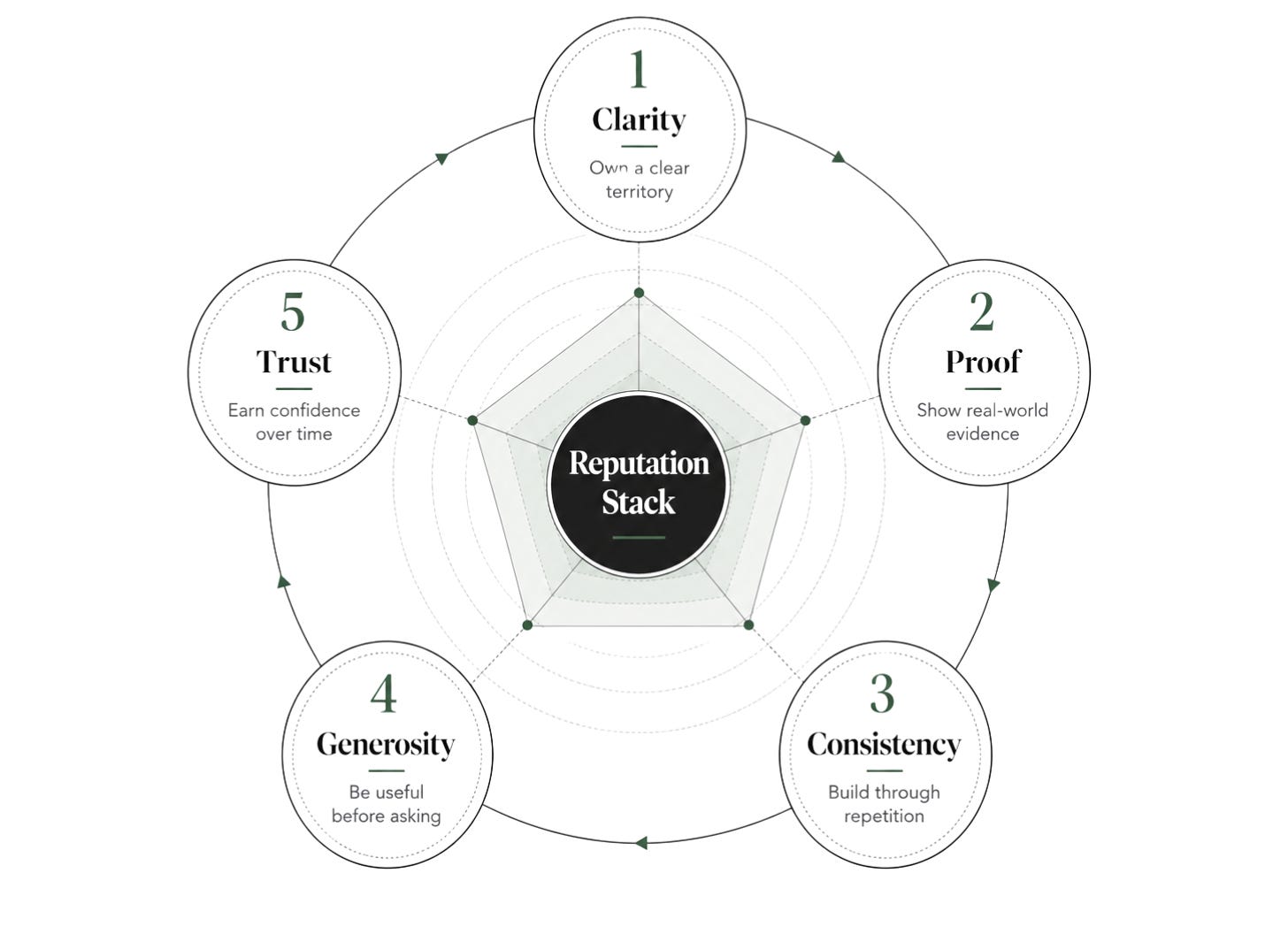
Each prompt corresponds to one step of the Reputation Stack we discussed last week.
The AI will not write your reputation for you. It will interview you, ask you one question at a time, wait for your real answers, and build something specific and true based on what you actually say.
At the end of the five prompts, premium subscribers will get the Master Prompt, which takes everything you generated and compiles it into a 90-day week-by-week action plan. Not a generic template. A plan shaped around your specific context, your personality, your time constraints, and your goals.
If you are interested in becoming a premium subscriber, I am offering this limited offer that will expire soon to get 20% OFF in your first year. Check here.
But we are getting ahead of ourselves... Let’s start from the beginning.
There is something uncomfortable about being asked to reflect on your own professional identity.
When a coach asks “what is your greatest strength?”, most of us either undersell ourselves out of modesty or oversell ourselves out of anxiety. Both responses are dishonest.
AI removes that social pressure. You are not performing for anyone. You can change your answer three times. You can say “I don’t know” and the AI will help you find out. You can be messy and exploratory without worrying about what someone thinks of you.
The prompts I am giving you are designed to instruct the AI to behave like a skilled interviewer: patient, specific, always focused on one question at a time, and oriented toward building something useful at the end of the conversation.
The key is that the AI will not rush you to a conclusion. It will ask, listen, and push you to be more specific when you are being vague. And the output it builds will be yours, because it came from your real answers, not from a generic template.
One important instruction before you start: run all five prompts in the same conversation if your AI tool allows it. That way the AI builds context as you go. Each step informs the next.
By the time you reach the Master Prompt, the AI already knows enough about you to build something genuinely personalized.
If your tool resets between sessions, copy your outputs from each step and paste them as context at the beginning of the next conversation. It takes an extra minute but it is worth it.
The Five Prompts
Prompt 1: Clarity
What this step is for
Most professionals are difficult to refer. Not because they are not good, but because the people who know them cannot explain what they do in one clear sentence. When your name comes up in a conversation you are not part of, the person speaking on your behalf either says something too vague (”she is really good at strategy”) or something too narrow (”he does project management”). Neither version opens the right doors.
Clarity is not about limiting yourself to a niche forever. It is about giving people an easy handle to hold when your name comes up. A specific enough description that the right person hears it and thinks: “That is exactly what we need.”
This prompt will help you define your Clarity Statement: the professional territory you own, expressed in language other people can actually use when they talk about you.
I want to define my professional Clarity Statement. This is a short, specific description of the problem I solve and the people I solve it for, so that anyone who knows me can refer me clearly and accurately without fumbling for words.

Before we get into the statement itself, I need you to understand me as a professional. Please act as a thoughtful strategic coach. Ask me one question at a time. Wait for my full answer before asking the next question. Do not summarize or conclude until I tell you I am ready.

Here is what I need you to understand through your questions:
- My current role and the industry I work in
- The type of problems I am genuinely good at solving, not just trained to handle
- Who the people are who benefit most from my work, and what they feel before and after I am involved
- What colleagues or clients tend to ask me for, even when it is technically outside my job description
- What would be missing or worse if I were not in the room
- What I want to be known for in the next three to five years, even if I am not quite there yet

After I have answered all your questions and I tell you I am ready, produce two versions of my Clarity Statement:
1. A LinkedIn headline version, under 15 words, specific and honest
2. An About section opening paragraph, three to four sentences, written in first person, that captures what I do, who I do it for, and what makes my approach different

Do not use generic phrases like "passionate about" or "results-driven." Make it specific to what I actually told you.

Start with your first question now.
Take your time with this one. The quality of your answers here shapes everything that comes after.
Prompt 2: Proof
What this step is for
Last week,
I wrote that a trophy says “look at what I did” but a reputation says “here is how I think when the work gets real.” The distinction matters more than most people realize.
Credentials tell people what you have done. Proof tells people how you think. And thinking is what senior decisions are actually based on. When someone is deciding whether to refer you, hire you, or partner with you, they are not running through your resume. They are asking themselves: “Do I trust how this person approaches hard problems?”
Proof is what answers that question before you ever have to say a word.
This prompt will help you build a Proof Bank: five to seven real situations from your professional life that demonstrate your judgment, your decision-making process, and the specific kind of value you create. These are not success stories polished for a job interview. They are honest accounts of how you handled real complexity, including what was difficult about it.
I want to build what I am calling a Proof Bank: a set of specific, real-world examples from my professional life that demonstrate how I think, what I value, and the kind of results I tend to create. I will use these in LinkedIn content, professional conversations, bio descriptions, and any context where I need to show rather than just tell.

Please act as a skilled interviewer whose job is to help me excavate the depth and specificity in my professional experience. Ask me one question at a time. Wait for my full answer. When my answer is vague, ask me to go deeper. When my answer is specific, acknowledge it and move to the next layer.

For each situation I describe, help me extract:
- The real context and what made it challenging or complex
- The specific decision or approach I chose, and what made it non-obvious
- What I had to give up or risk to make that choice
- The result, including any messy or unexpected parts
- What this example reveals about how I think, not just what I did
- A one or two sentence Proof Statement I can use in a post or conversation

Help me identify at least five strong situations. Push me past the first examples I give you, which are usually the safe, polished ones. The best proof points often hide behind the ones we mention second or third.

After we have worked through at least five situations, organize them into my Proof Bank: a structured list I can refer back to whenever I need to write content or talk about my work.

Start by asking me to describe a situation from my career where I had to make a genuinely difficult call, one where there was no obviously right answer.
Do not skip the messy parts. The moments of real uncertainty are the ones that make proof believable.
Prompt 3: Consistency
What this step is for
I want to be direct about something: the reason most professionals never build a visible reputation is not lack of ideas. It is the gap between what they plan to do and what they actually do when Monday arrives and the week gets heavy.
Consistency is not about willpower. It is about design. A publishing rhythm that fits your real life, your real schedule, and your real energy is one you will keep. A publishing rhythm designed for the version of yourself you wish you were is one you will abandon in three weeks and feel guilty about for months.
This prompt will help you design a content rhythm that is honest about your constraints. Not impressive on paper. Actually executable. Because one thoughtful post every two weeks for a full year does more for your reputation than a perfect editorial calendar you followed for twenty-two days.
I want to design a Consistency Plan for building my professional reputation online. The word "consistent" is key here. I do not need an ambitious plan. I need a realistic one I will actually follow for at least ninety days without burning out or disappearing.

Please act as a content strategist who is deeply skeptical of plans that look good but fall apart in real life. Ask me one question at a time. Wait for my full answer. Challenge me if my answers sound too optimistic. Push me toward what is actually sustainable, not what sounds impressive.

I need you to understand the following through your questions:
- My real weekly schedule and the hours I can honestly dedicate to content creation
- The platforms I already use or where my professional audience actually is
- The formats that feel natural to me, not just the ones that seem popular
- What has stopped me from being consistent in the past, specifically
- The topics I could write or talk about without needing to do research because I live them every week
- Whether I prefer to create in batches or in small daily doses
- How I feel about being visible online, including any discomfort or resistance

After you understand my real constraints and preferences, design a ninety-day Consistency Plan structured by week. Each week should include:
- One main topic or theme
- One format and one platform to focus on
- A realistic time estimate for creating that week's content
- One low-effort "generosity move" (a comment, a share, a short response) that keeps me visible even in busy weeks

The plan should feel like something a real person with a full job could actually execute.

Start with your first question now.
Be honest about what has stopped you before. That conversation is usually the most useful part.
Prompt 4: Generosity
What this step is for
The fastest way to make visibility feel less like self-promotion is to lead with genuine usefulness. Generosity is not a tactic. It is the actual antidote to the cringe we talked about last week.
When you give something real, something that makes a person think more clearly or handle a problem better, you are not promoting yourself. You are demonstrating your thinking. And demonstration is always more convincing than declaration.
The interesting thing about generosity is that it scales asymmetrically. A single thoughtful comment you leave on someone else’s post can reach five hundred people you have never met. A short reflection you share about a mistake you made can become the most trusted thing on your profile. Sometimes the smallest things create the most durable reputation.
This prompt will help you identify your natural generosity moves: the specific things you can share, teach, or offer that are genuinely low-effort for you but genuinely high-value for the people you want to reach.
I want to identify my Generosity Moves: the specific ways I can be genuinely useful to my professional community without it feeling like performance or self-promotion. These are the things I give away freely because I actually care about helping people think better or work better in my area of expertise.

Please act as a strategic thinking partner. Ask me one question at a time. Wait for my full answer. Help me identify things that feel natural and low-effort for me but that others find genuinely valuable, because those are usually the most sustainable form of generosity.

Help me explore the following through your questions:
- What questions do people ask me most often, at work, at events, or in informal conversations
- What knowledge or perspective do I have that I sometimes assume everyone else has too
- What mistakes do I see people making repeatedly that I have already learned not to make
- What frameworks, tools, or approaches do I use daily that I have never bothered to explain to anyone else
- Where do I currently engage with other people's content, and how could I do that more intentionally
- What would I share freely with a junior colleague or a friend entering my field

After you understand my natural knowledge and instincts, produce:
1. A list of five to seven Generosity Moves I can make this month, ranging from very small (a comment, a reaction, a DM) to medium (a short post, a shared reflection) to slightly larger (a practical guide or framework post)
2. A short description of my natural "generosity style," the way I tend to teach or share that feels most authentic to me

Start with your first question now.
The things you give away most easily are often your most valuable assets. This prompt helps you see them.
Prompt 5: Trust
What this step is for
Trust is not something you build directly. It is what accumulates when Clarity, Proof, Consistency, and Generosity work together over time. But trust also leaks. And it leaks in specific places that are worth knowing.
Maybe your LinkedIn profile says one thing but your content says another. Maybe you show up generously on other people’s posts but never share your own perspective. Maybe you have strong Proof in private conversations but none of it is visible anywhere online. Maybe you are consistent for three weeks and then disappear for six.
Every one of those gaps is a trust leak. And most professionals have several of them without realizing it. This prompt is a diagnostic. It helps you identify exactly where your current reputation is strong and where it is quietly undermining the work you are already doing.
I want to run a Trust Diagnostic on my current professional reputation. The goal is to identify specifically where my reputation is strong, where it is weak, and where there are gaps between how I present myself and what someone would actually find if they looked me up or asked around about me.

Please act as a rigorous and honest diagnostic partner. Ask me one question at a time. Wait for my full answer. Do not reassure me unnecessarily. Your job is to help me see the real picture, including the uncomfortable parts.

I need you to explore the following through your questions:
- What someone would find if they searched my name online right now, and whether that matches how I want to be known
- Whether my LinkedIn profile, my content, and my in-person reputation tell the same story or different ones
- Where I tend to disappear or go quiet, and what triggers that
- Whether the people who could refer me actually know enough about my work to do it well
- What the last three things I shared publicly said about how I think, and whether that is what I want people to associate with my name
- Whether there are parts of my professional identity I have never made visible because I was not sure they were "appropriate" to share

After you have a clear picture of my current state, produce a Trust Diagnostic Report that includes:
1. My three biggest reputation strengths right now
2. My three biggest trust leaks, the gaps between intention and perception
3. A prioritized list of three actions I should take in the next thirty days to close the most important gaps

Be specific. Vague feedback is not useful here.

Start with your first question now.
This is the hardest conversation of the five. It is also the most useful one.
You Now Have Five Conversations Worth Having
If you run all five of these prompts with honest answers, you will end up with:
A Clarity Statement you can actually use on LinkedIn and in conversations
A Proof Bank of five to seven real situations that demonstrate your judgment
A realistic Consistency Plan you might actually keep
A set of Generosity Moves you can start this week
A clear picture of where your reputation is strong and where it leaks
That is already more than most professionals ever build deliberately. Most people let their reputation accumulate by accident, shaped by whoever happened to be watching, however they felt like showing up that day.
You are choosing to build it on purpose.
But here is where most people get stuck again. Not in the exercises. After them.
They do the five prompts, they generate real material, they feel a moment of clarity, and then Monday arrives, and the clarity evaporates because there is no structure telling them what to do next, in what order, with what rhythm, adapted to who they actually are.
That is what the next section is for.
Don’t leave your reputation to chance or the whims of an algorithm.
Take the next step in your professional evolution:
Review the Sources: See the logic behind the strategy at Sources & Giants.
Use the Resources: Download the guides on the Resources Page.
Upgrade to VIP: Get the complete execution framework via VIP Access.
