

You finished a dozen things last year that mattered.
Different teams, different people, different levels of pressure. Some landed on time. One was a mess from the third week and never really recovered.
A couple were honestly good, the kind where the team clicked, the work came out clean, and you went home on Friday feeling like you actually did something that counted.
Then January comes… Your manager schedules the year-end review. Salary implications somewhere in the background, the kind everyone pretends not to think about and everyone thinks about. She opens the document, looks up, and asks the question you knew was coming.
“So, tell me about your year. What did you do that made a real difference?”
And you freeze.
Not because nothing happened.
Because you cannot remember.
A dozen efforts blurred into one long stretch of meetings, status updates, and urgent messages landing at 4:55 on a Friday. You remember the stress. You remember the tense call somewhere in the middle of the hardest one, the night it almost went sideways.
But the specifics?
The decisions that actually changed the outcome.
The moment your judgment quietly saved something.
The trust you built with someone who started the year not believing in you at all.
Gone.
So you do the thing most of us do. You improvise. You say something vague about “delivering value” and “managing complexity,” words that mean nothing and everyone in the room knows mean nothing. You walk out having undersold a full year of real work.
Not because the work was bad. Because you never stopped to write any of it down.
That is what this is about. And it is one most of us have lived, on both sides of that desk.
Most professionals know how to run a project retrospective. What went well, what did not, and what we will change next time.
Sticky notes, a whiteboard, maybe a template someone forwarded you in 2019. It is useful. It helps the team.
But here is the thing nobody says out loud.
The team or project debrief captures what happened to the work. It almost never captures what happened to you.
Your decisions sit nowhere in that document. Neither does the person you handled beautifully, nor the one you avoided for two weeks longer than you should have. The moment you felt completely out of your depth and somehow found a way through. The risk you saw coming when nobody else did. None of it ends up in the official record, because that record was built to protect the organization, not to grow the person doing the work.
So it evaporates. And the next thing starts clean, which sounds nice, except “clean” also means you carry every pattern you never examined straight into it.
Donald Schön, in The Reflective Practitioner, drew a line between two kinds of thinking. Reflection in action, the thinking you do on your feet while the thing is still happening. And reflection on action, the looking back you do afterward to understand what you actually did, and why.
Most of us are decent at the first one. We think fast when everything is on fire. We are terrible at the second one, because the second one requires stopping. And work does not stop. There is always a handover, a kickoff, a new set of people pulling at your calendar before the last thing has even finished cooling down.
The solo debrief is reflection on action with a structure. It is private. It is yours. And it takes 45 minutes.
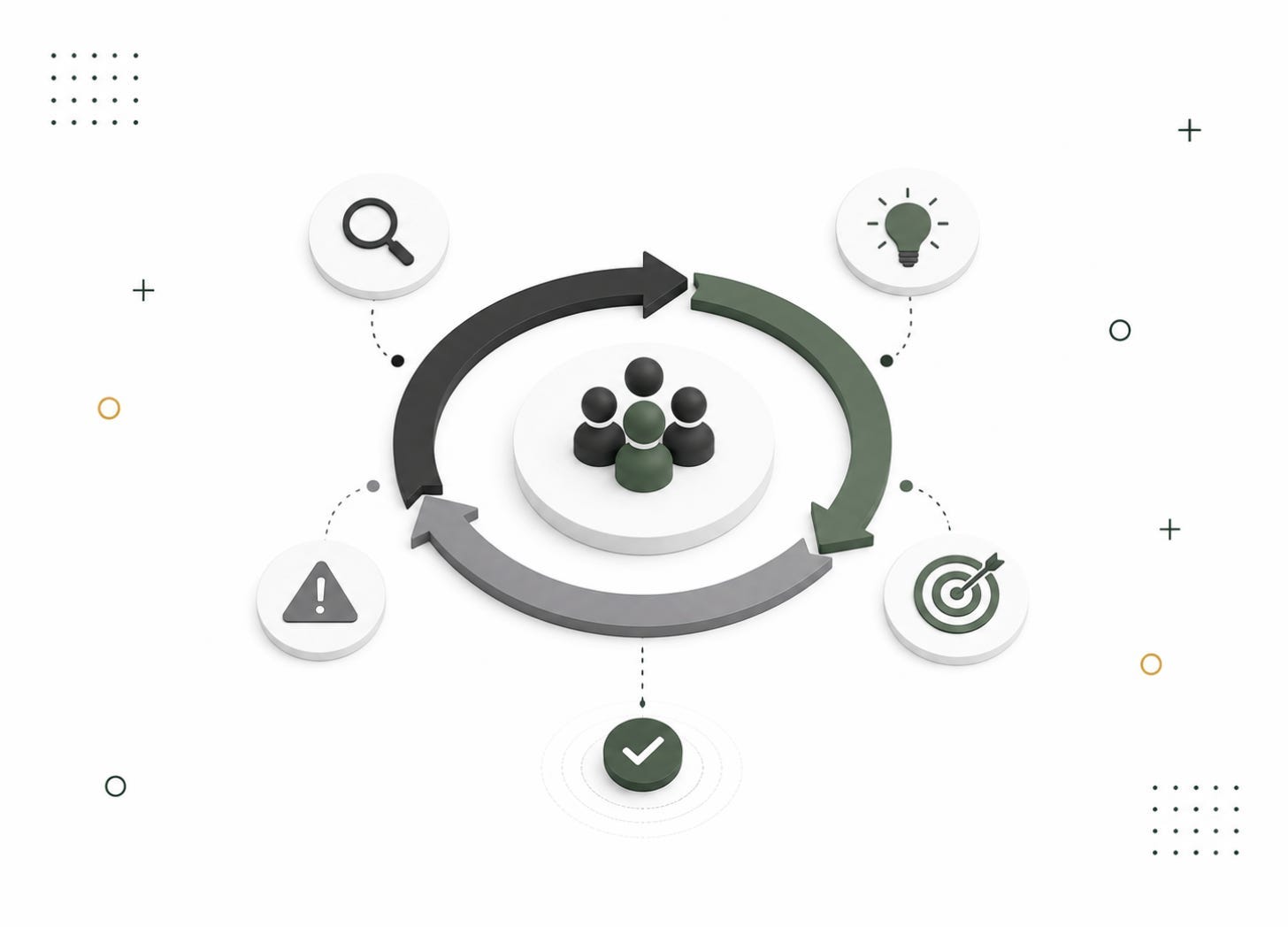
The Four Mirrors
Call them the Four Mirrors, because that is really what they are. Four questions, each one showing you a different part of your own performance.
Not the work’s performance. Yours. You answer them alone, in writing, within one week of something closing.
The writing part is not negotiable, and we will come back to why. For now, just the four…
Mirror 1: What did I actually decide?
Not the calls made above you. Not the ones handed down. The ones that were genuinely yours. The trade-off you made, who you pulled in, the way you handled a problem the moment it stopped being a risk and became real, when you raised your hand and when you decided to carry it quietly.
Pick the three that mattered most. For each one, write what you knew at the time, what you weighed, and what you would do differently now.
The point is not to grade yourself. The point is to catch your own decision-making before it hardens into a habit you can no longer even see. And there is one question inside this mirror worth more than the rest.
Was there a decision that looked fine on the surface, but you already knew, in the moment, was not quite right?
Those are the ones to name. We all have them. The call we made because it was easier, not because it was correct. Writing it down once is how you stop making it twice.
Mirror 2: What did I keep avoiding?
This is the uncomfortable one. Sit with it anyway.
Almost every piece of work has something you knew needed to happen and kept finding clever reasons to postpone. A hard conversation with a difficult person. An honest update that would have triggered a question you did not want to answer. Someone whose work was slipping, and you kept hoping it would sort itself out.
It rarely sorts itself out.
Write it down. One or two things, named honestly. Not “communication challenges,” which is the kind of phrase we all hide behind. The actual thing. You avoided telling someone their estimates were unreliable because you did not want the conflict, and it cost two weeks. That specificity is where the entire lesson lives. The vague version teaches you nothing. The specific one is almost impossible to ignore next time.
Mirror 3: Where did I lose and earn trust?
Work runs on trust the way an engine runs on oil.
You can have a full tank, a great plan, a perfect schedule, and still seize up completely if the trust is gone. Most people only notice the oil when it runs out.
So think about two or three key relationships. Where did you lose ground? Where did you earn it back? Was there a moment someone quietly stopped relying on you, and do you actually know why? Was there one who started trusting you more than you expected, and can you name what you did to deserve it?
You are not scoring yourself here. You are trying to understand how you move through relationships when you are under pressure, because that pattern will repeat on every job, every team, every project, until the day you finally catch it.
Mirror 4: What surprised me?
Surprises are not bad luck. They are information about you.
If something caught you off guard, that is a signal about the gap between the work you thought you were doing and the work that was actually happening. Write down the two or three things that surprised you most. Then ask the only question that matters here. Was the signal there earlier and you missed it, or was this genuinely impossible to see?
Be honest about which one it was.
And here is where it gets useful over time. Do this enough times and your surprises start to cluster. You notice you keep getting blindsided by the same kind of thing. The same misread brief. The same office politics two levels above you. The same dependency you assumed someone else was watching.
That cluster has a name. It is your blind spot. And a blind spot you can finally see is one you can start to manage.
How to Actually Do It
A framework that lives only in an article is worth nothing.
So here is exactly how to run it.
Block 45 minutes within the first week of something closing. Not a month later, when the memory has gone soft and the urgency has drained away. One week, while it is still warm.
Use a private document, somewhere outside your work systems. Not the shared drive where someone might stumble onto it. This is the one place where you get to be completely honest, and you cannot be honest if part of your brain is worried about who else can read it. A notes app, a plain text file, an actual notebook if you are old school. Whatever you will genuinely open.
Write in full sentences. This is the part people want to skip, and it is the part that does all the work.
Compare these two.
“Call, week four, moved too fast.”
“The call in week four was probably right given what I knew, but I moved too fast and never brought the right person into the conversation early enough, which cost me their trust for the rest of the job.”
The first is a note you will not understand in six months. The second is a lesson. The friction of finishing the sentence is exactly what forces the thought to complete itself. Bullet points let you lie to yourself by leaving the hard half unwritten.
Then keep every debrief in one place. A running log. Date, name of the work, the four answers. One after another, all in the same file.
And then do the thing almost nobody does. Every three or four entries, read the whole log back.
That is where it stops being a habit and starts being a mirror you can actually see yourself in. One debrief tells you about one piece of work. Five of them, read together, tell you who you are. The patterns you would never catch inside any single project show up immediately when they line up on the same page.
Back to January
So let me close where we started…
Your manager opens the year-end review and asks what you did that made a difference.
Only this time, you are not improvising. You are not reaching for “delivering value” because your mind went blank. You open your log, and the year is right there.
The decision in March that prevented a six-week delay. The way you rebuilt how updates went out on the second big push, because the old rhythm was creating noise instead of confidence. You can show the before and the after on both.
That is not bragging. Bragging is empty.
That is evidence.
And it came from 45 honest minutes at the end of each piece of work, all year long, while everyone else moved straight to the next kickoff and forgot.
The solo debrief was never really a self-improvement exercise. It is a professional record of your own judgment, kept by the one person in the entire organization who is genuinely paying attention to it.
That person is you. Nobody is coming to write it down for you.
So before the next thing closes and the one after it swallows you whole, here is the only question that matters.
When January comes and someone asks what you actually did, will you remember? Or will you freeze again?
The difference between a professional who is “busy” and one who is “influential” often comes down to the quality of the assets they build.
Don’t leave your reputation to chance or the whims of an algorithm.
Take the next step in your professional evolution:
Review the Sources: See the logic behind the strategy at Sources & Giants.
Use the Resources: Download the guides on the Resources Page.
Upgrade to VIP: Get the complete execution framework via VIP Access.
Those four questions are true magic in what they can reveal.
All too often we dismiss what's easy for us and confuse it with lacking value.
The impact it has/had for others is the tell all.
Your questions are a great guide to uncovering evidence of our superpowers.