

If you find value in these reflections, you are likely missing out on the deeper, more specialized layers connected with this ecosystem built to improve you:
The Foundation: Understand the frameworks and mentors that inform this methodology at On the Shoulders of Giants.
The Toolkit: Access the Free Resources to start auditing your current digital footprint.
The Accelerator: For those ready to bypass the trial-and-error phase, the VIP Premium Packs provide the exact systems used to scale professional influence.
Ah… And if your focus is not only on your visibility, but also learn the internal systems of your career and personal growth, you should check Meller Notes.
There is a question that sounds silly but kept me uncomfortable for days.
Why do I do what I do?
The what, I can say without thinking. I read, I process books, I write about them. The how too, more or less. But the why I had never sat down to put into words.
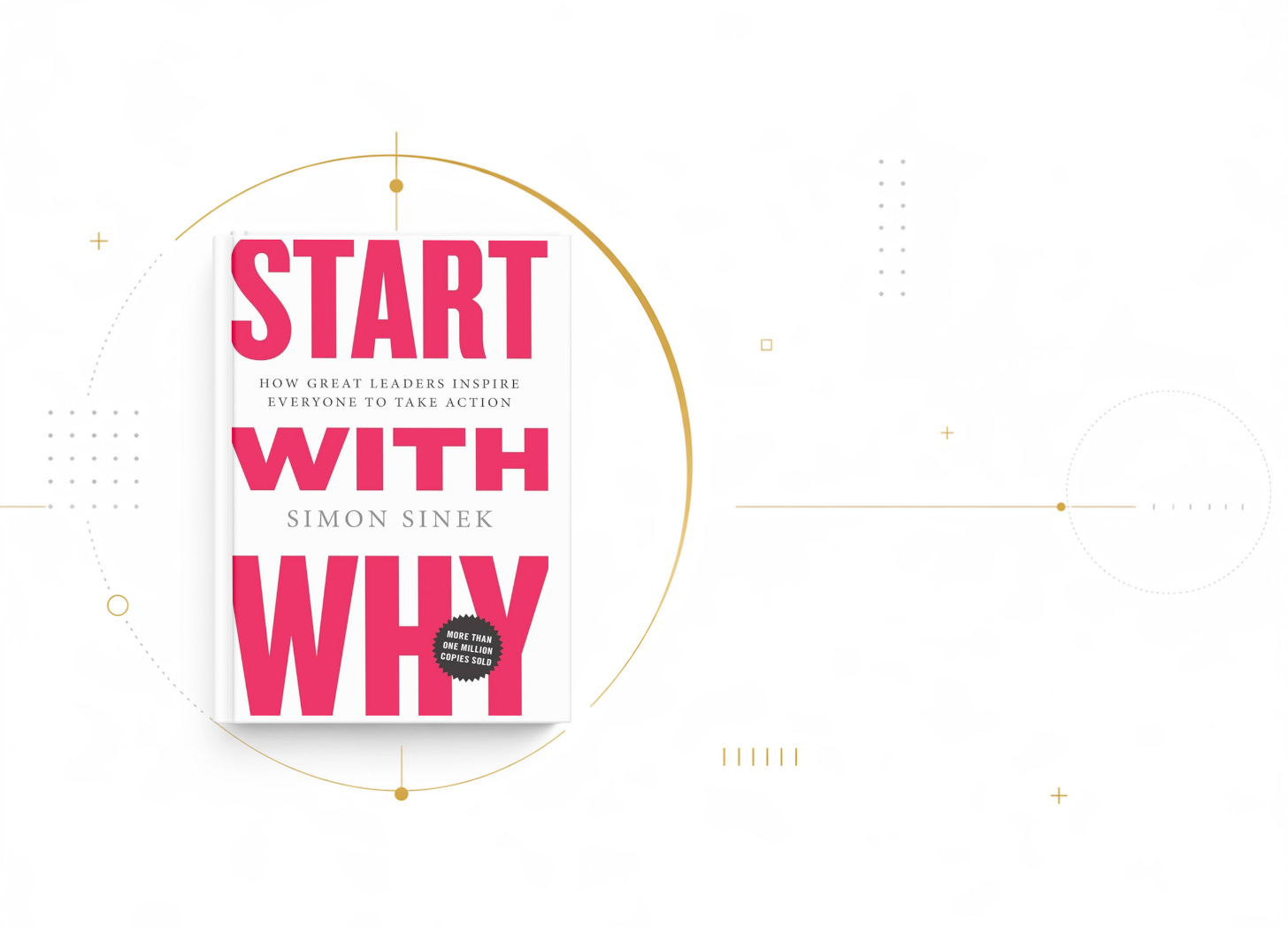
And that is exactly the knot Simon Sinek handed me to untie in Start With Why, his 2009 book that became one of the most watched TED Talks in history.
I came to it sideways, suspicious because of all the fame. That thing of a book that turns into a badge for motivational speakers.
Spoiler: It was better than I expected. Much better.
But there is also a hole in the middle that almost nobody talks about, and we will get there, slowly, because intellectual comfort is stagnation, and I do not write here just to praise a book.
Grab a coffee…
What we will look at here
The world that does not start with why, and why most of us live in it
Manipulate or inspire, the only two ways to move behavior
The Golden Circle, the idea that fits on a napkin
Why this is biology, not stage talk
Leaders need followers, and followers need to trust
The Law of Diffusion, or why a good product sometimes dies on the shelf
The biggest enemy of purpose, which is not failure, it is success
Where the why comes from, and why you find it looking backward
Where Sinek’s argument wobbles
An exercise to find your own why
What to remember from this book
If you keep only this and forget the rest, keep these points. It is more or less everything my future self should know about Start With Why.
People don’t buy what you do, they buy why you do it. The spine of the whole book. The product is the proof of the purpose, not the reason to buy.
The Golden Circle has three layers. The what, the how, and the why. Inspiring people communicate from the inside out. Most do the opposite.
The why is not profit. Profit is a result. The why is the cause, the belief, the reason you get out of bed.
This is biology, not motivation. The limbic brain decides but cannot speak. The neocortex speaks but does not decide. Communicating the why hits the organ that decides. Listing features hits only the one that rationalizes.
There are two ways to move behavior: manipulate or inspire. Price, promotion, fear, aspiration, peer pressure, and novelty work in the short term and cost a lot in the long term.
Manipulation creates transactions, inspiration creates loyalty. Loyalty is when someone turns down something better to stay with you. Repeat business you can buy. Loyalty, you cannot.
Trust is a feeling, not a checklist. It grows from shared belief, not from ticking obligations.
Hire people who believe what you believe. Skills you can teach, belief you cannot.
Before the masses, win the ones who decide by belief. The Law of Diffusion says the first 15 to 18 percent move the rest.
The biggest enemy of purpose is success, not failure. When the company grows and the founder leaves without putting the why into words, the what takes over and manipulation comes back.
What gets measured gets done. If you measure only money, money is what you optimize.
The why is discovered, not invented. It comes from the past. Like an arrow that has to be pulled backward to gain momentum.
Watch out for the holes in the book. Strong on diagnosis, weak on the recipe for finding your why. And the logic works for any cause, good or bad. The engine does not pick the destination.
The world that does not start with why
Most companies do not know why their customers are their customers. And if they do not even know that, they have no idea why their employees are their employees either.
Think about it for real. Most would say “well, my customers choose me for the quality, the price, the service.”
And Sinek shows, case after case, that this is almost never the real reason. Because there is always a competitor with similar quality, similar price, similar service.
If that were all, nobody would be loyal to anybody.
He opens with a story I loved. A group of American executives visits a Japanese car assembly line. At the end of the line, they notice a step is missing.
In the United States, a worker took a rubber mallet and tapped the edges of the door to make sure it fit right. In Japan, nobody did that.
The Americans ask where the guy who adjusts the door is.
